I was about to start a content site about AI tools, and before I had written a single article, I was already staring at $108 a month in software subscriptions.
Webflow for the site itself: $29 a month. Jasper for writing at volume: $49 a month. Midjourney for hero images: $30 a month. Three tools, three monthly charges, three login screens, and no audience yet. The site didn't exist. No one had read a word. And I was already paying more per month than my phone bill.
The spreadsheet sat open on my screen for an hour that evening. I kept coming back to the same question. Every one of those three tools was, at its core, a dressed-up interface for something a general-purpose AI could already do. Claude could write. ChatGPT could generate images. Claude could produce HTML and CSS if I described what I wanted clearly enough. I was about to pay $108 a month to access AI capabilities through three separate wrappers when the capabilities already existed in tools I was either paying for or could use for free.
The conventional content marketing advice was unanimous: use a proper website builder, use a proper AI writing tool, use a proper image generator. Every "how to start a blog" article said the same thing. I read a dozen of them. They all recommended some variation of this stack. The advice felt authoritative because it was everywhere.
I spent a week going back and forth. Part of me wanted the safety of doing what everyone else does. Part of me kept staring at the $108 number and asking whether these tools earned their price at my scale. The answer, for my specific situation, was that they didn't. Someone publishing fifty articles a month might need Jasper's bulk workflow. Someone building a complex interactive site might need Webflow's visual editor. I was publishing once or twice a week and needed a clean reading experience. My use case was generic, and I was about to pay for specialisation I wouldn't touch.
So I cancelled all three before I ever signed up, and built the whole thing with what I already had. What follows is an honest account of what worked, what I gave up, and where the conventional advice was right that I just didn't need it.
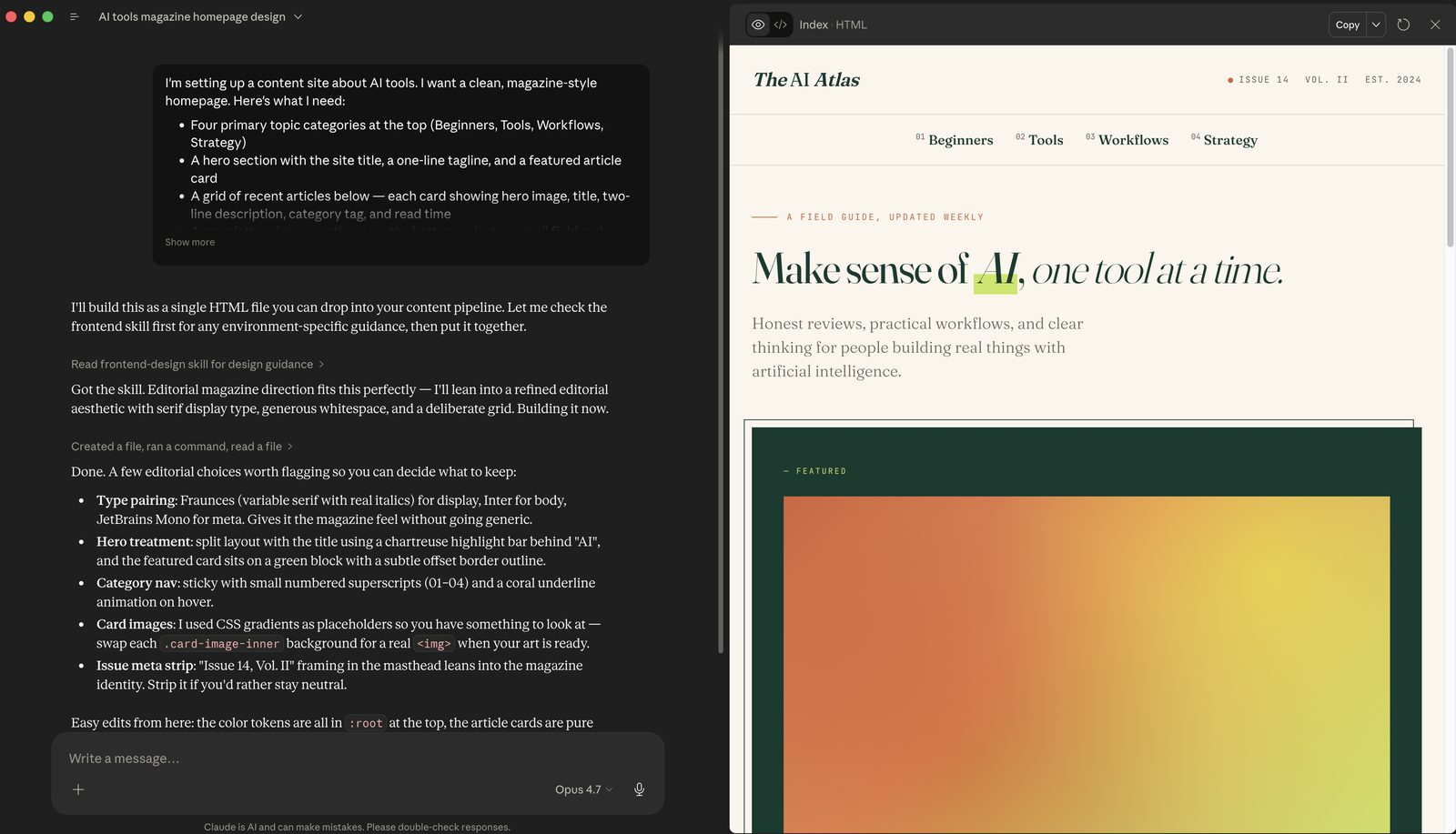
The first thing I replaced was Webflow. The standard path would have been to pick a template, drag blocks around, customise colours and fonts, and publish. Instead, I opened a conversation with Claude and described what I needed: a content site about AI tools, four primary topic categories, an article archive page, and a simple newsletter signup form. I asked Claude to generate the HTML and CSS structure for the whole thing.
The first version came back in about ten minutes. It was structurally sound but visually basic — a clean skeleton with the right sections in the right places, but none of the personality I wanted. I described what I wanted changed: wider content column, different font stack, more whitespace between article cards, a dark navigation bar, article cards that showed the hero image and first two lines of the description. Claude revised. I described more changes. The newsletter form needed to be simpler. The category navigation needed to work on mobile. The footer was too cluttered. This went back and forth for an afternoon, roughly three hours of iteration, before I had a site structure I was satisfied with. I pushed the files to Cloudflare Pages, which hosts static sites for free. The site was live by evening. Total monthly cost for hosting: zero.
The honest trade-off here matters. I gave up Webflow's drag-and-drop editor. Every change to the site now means going back to Claude or editing the HTML files directly. For someone who thinks visually and wants to rearrange layout elements by clicking and dragging, Webflow is still the better tool. For someone comfortable building a website with AI by describing what they want in words, Claude produced a $29-a-month saving with more control over the final output. The site looks exactly how I described it, because I described it in detail. The effort shifted from learning a visual editor to learning to be specific in conversation.
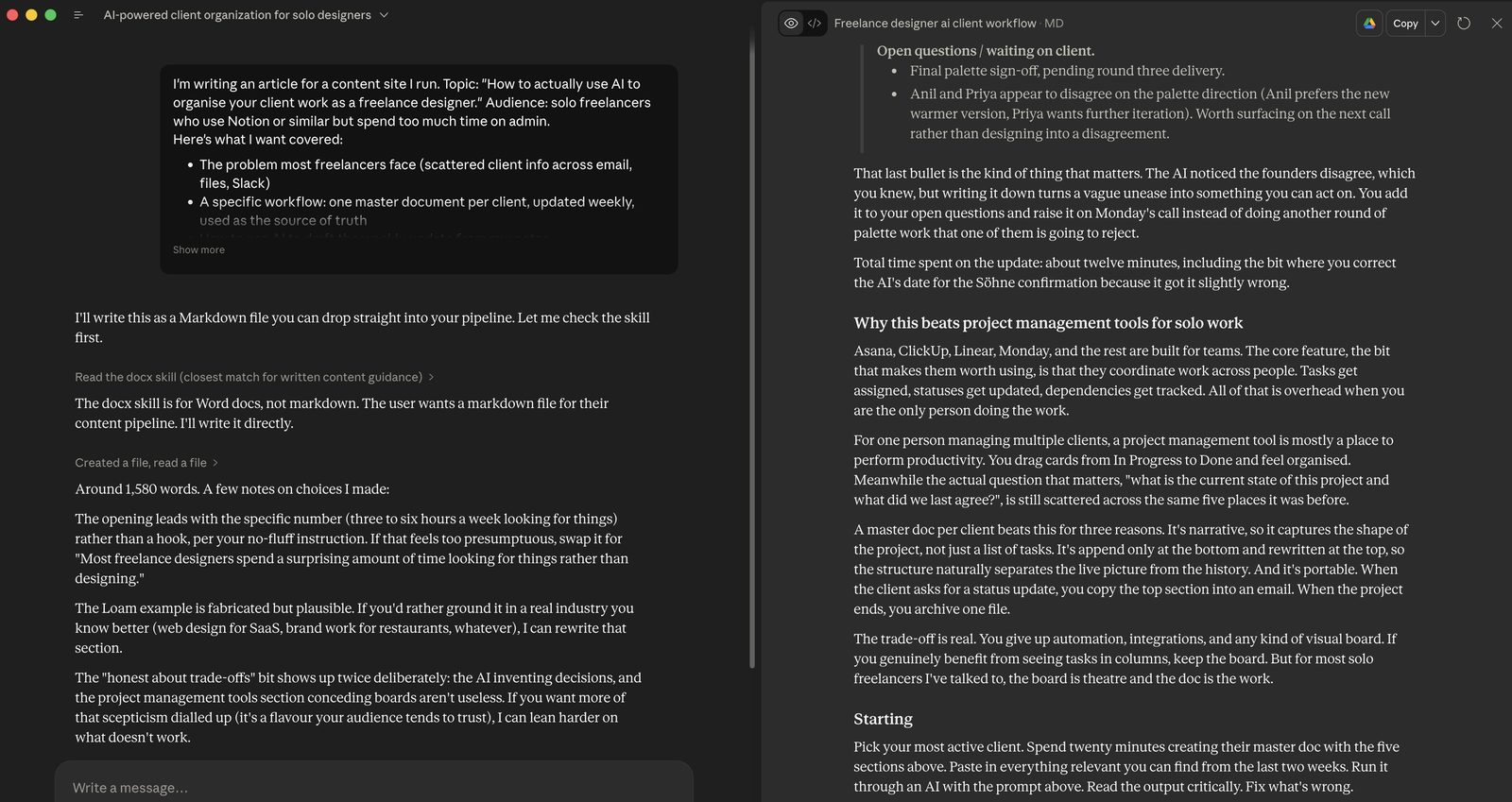
The writing tool was the subscription I expected to miss most. Jasper's pitch is compelling: pick a blog post template, choose a topic, get a 1,500-word article in five minutes. For someone running a content operation at scale, that workflow has real value. I tried a free trial before deciding, and what I found surprised me. The templates were actually the weakest part. They constrained the output into a predictable structure that read like every other AI-generated blog post on the internet. The articles hit all the expected beats in the expected order with the expected transitions. They were competent and completely forgettable.
A blank Claude conversation with a detailed prompt produced something different. I could describe the specific angle I wanted, the tone, the structure, the points that mattered, the points that didn't. I could paste in research, competitor articles, my own notes, and tell Claude to synthesise all of it into a draft that hit specific arguments in a specific order. The output was longer, more specific, and less generic than what the template-driven approach produced. The writing still needed editing, sometimes heavy editing, but the raw material was better because it wasn't squeezed through a predefined shape. The difference was the difference between a mad lib and a conversation. One fills in blanks. The other responds to context.
The honest trade-off: Jasper has features Claude doesn't replicate. Brand voice training that learns from your existing content. Bulk generation for producing dozens of pieces from a content calendar. Built-in SEO scoring that flags keyword gaps before you publish. If someone is generating fifty articles a month for client projects, those workflow features probably save enough time to justify $49 a month. I publish one or two pieces a week, which means Claude's longer per-article setup time is irrelevant. The match between tool and use case matters more than the tool's raw capability. For the differences between general-purpose AI tools, the distinction is less about which is smarter and more about which fits the way you work.
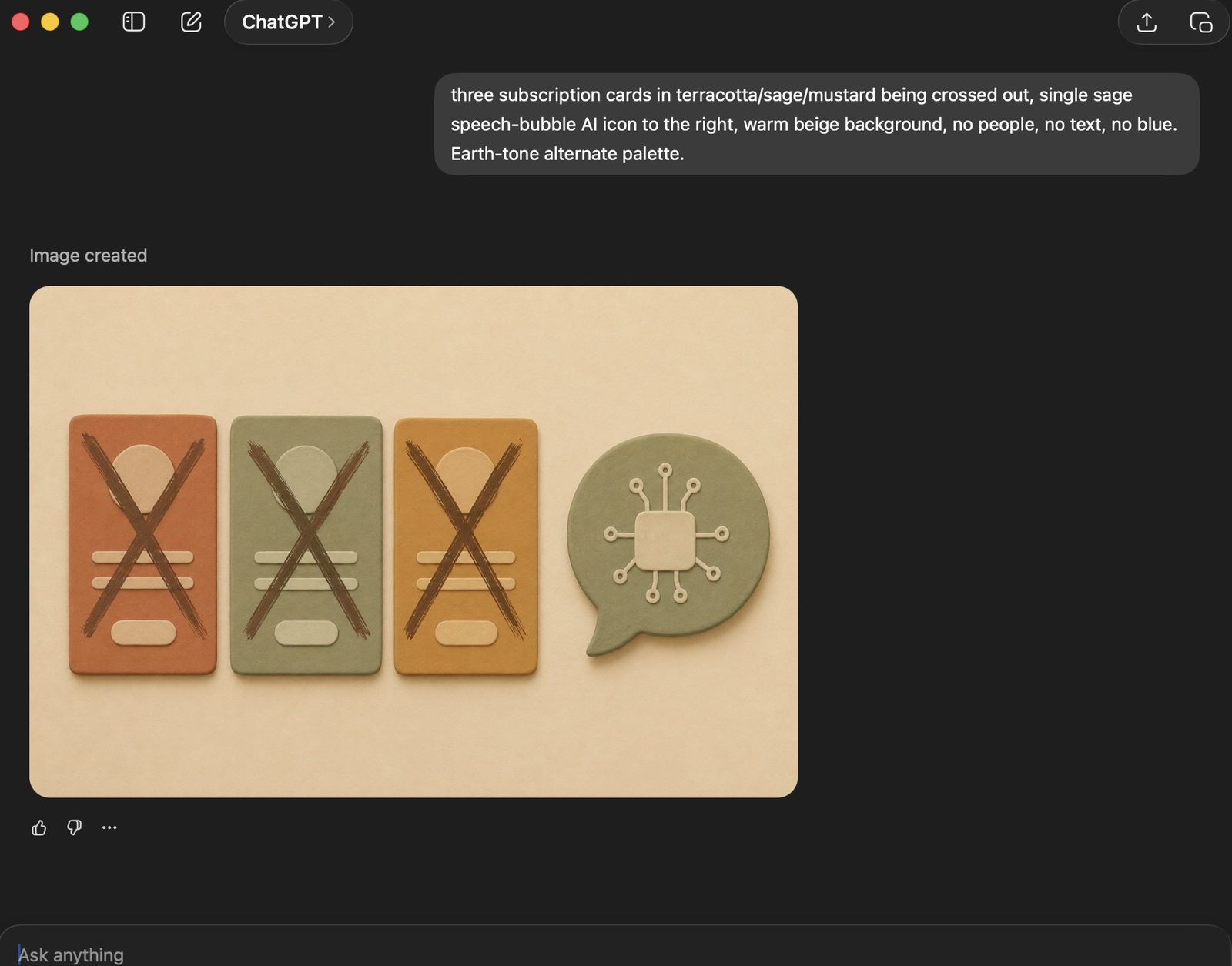
The image problem was the simplest to solve and the one I had the most doubt about before trying. Every article needs a hero image. The standard answer was Midjourney at $30 a month. Midjourney is good. I've reviewed AI image generation tools elsewhere, and the quality ceiling on Midjourney remains higher than any competitor for certain styles: illustrative consistency, specific aesthetic moods, compositional control that feels intentional rather than random.
But I didn't need the quality ceiling. I needed one passable hero image per article — something that communicated the topic at a glance and didn't look like clip art from 2014. ChatGPT's image generation, on the free tier, cleared that bar. Not with the stylistic polish of Midjourney. Not with the speed of a dedicated generation tool. But at a cost of exactly zero dollars. The process was simple: I described the image in a few sentences, specified the colour palette and composition I wanted, and ChatGPT returned something usable within a minute. Sometimes the first attempt missed. A second prompt with more specific direction fixed it.
The distinction matters: this is the free tier of ChatGPT. Not a paid subscription to another service. Not a cost bundled into something else. The replacement cost for Midjourney, for my specific use case, was literally nothing. I describe the image I want, ChatGPT generates it, I use it. The hero images on the site are not winning design awards. They communicate the article's subject at a glance, which is all they need to do. For a site building a cohesive visual brand across hundreds of images, Midjourney's consistency tools would be worth $30 a month. For a content site where each article stands alone and the image just needs to be adequate, free works.
I added it up after the first month. $29 for Webflow, gone. $49 for Jasper, gone. $30 for Midjourney, gone. $108 a month I didn't spend. $1,296 over a year. For a side project that hasn't started earning revenue yet, that number isn't trivial. It's the difference between a project that needs to start making money immediately to justify its costs and one that can grow at its own pace.
But the dollar figure isn't the part that stuck with me. The pattern is what matters.
Every one of those three cancelled subscriptions followed the same logic. A specialised AI tool took a capability that exists in general-purpose AI, wrapped it in a workflow interface, added some niche features, and charged a monthly fee. The wrapper adds real value for people whose work is heavy enough to need it. Jasper's templates save time if you're producing content at industrial scale. Webflow's visual editor saves time if you're iterating on complex layouts daily. Midjourney's stylistic controls save time if visual brand consistency is a core requirement.
For everyone else, the general-purpose tool already in the stack does the same job. The pattern repeats across categories. Specialised AI writing tools wrap the same language models in workflow templates. Tools that let you describe what you want and watch it built wrap the same code generation in visual interfaces. The wrapper earns its subscription when the niche features get used constantly. When they don't, the subscription is paying for convenience that a clear prompt could replace.
This isn't an argument that specialised tools are scams. They're not. They're a question of fit. The honest test is simple: would I use this tool's unique features ten times this month, or once? If the answer is once, the general-purpose AI already in the workflow is the answer. If the answer is ten times or more, the specialised tool earns its fee.
The broader shift here is the same one happening across the broader shift from asking AI questions to building with AI. The default assumption used to be that every task category needed its own tool. Writing needs a writing tool. Images need an image tool. Website building needs a website builder. That assumption made sense when the tools were doing fundamentally different things under the hood. It makes less sense now that a single conversation with Claude or ChatGPT can produce the same outputs, as long as the person using it knows what to ask for. The skill that replaces the subscription is specificity. Describe what you want in enough detail, and the general-purpose AI builds it. The people who still need the wrapper are the ones whose volume or complexity justifies the workflow shortcuts. The people who don't need it are the ones paying for a streamlined interface to a capability they could access directly with a better prompt.
My suggestion, for anyone reading this who subscribes to more than a couple of AI-adjacent tools: open a spreadsheet. List every paid subscription. Next to each one, write what the tool actually does in your workflow. Not what its marketing page says. What you personally use it for, this month, in concrete terms. Then ask, for each line, whether Claude or ChatGPT, given the right prompt and enough context, could produce the same output. Be honest in both directions. Some tools will pass the test because they do something AI simply can't. Others won't, and those are the subscriptions worth questioning.
The savings from the ones that don't pass will be larger than expected. Not because the tools are overpriced, but because the gap between what a specialised AI wrapper does and what a general-purpose AI does has been shrinking every quarter, and most people's mental model of that gap hasn't caught up. A year ago, I would have needed Jasper because the general-purpose models weren't good enough at long-form writing to replace a dedicated tool. Six months ago, I would have needed Midjourney because free image generation wasn't close. The window during which each specialised tool is strictly necessary keeps getting shorter, and the subscriptions keep renewing on the old schedule.
I looked at the $1,296 I didn't spend this year and decided to put it somewhere specific. A domain renewal. A Cloudflare Pro plan I don't strictly need yet but that gives me better analytics. A year's subscription to someone else's newsletter that I learn from every week. The point was never austerity. The point was choosing what to pay for deliberately, instead of inheriting a tool stack from a content marketing blog that was written before general-purpose AI could do most of what those tools charge for. Three subscriptions cancelled. One afternoon spent. A content site that works exactly the way I described it, running on tools I was already using, at a cost that lets it exist without pressure to earn its keep on day one.