TL;DR: I set Perplexity as my default search for 30 days and used it for everything, not just research. It wins for research, comparisons, and "help me understand" questions — synthesised answers with every claim sourced. I went back to Google for navigation, local and "open now" lookups, instant single facts, and shopping, tasks where a link beats a paragraph. The skill is knowing which kind of question you're asking before you type, not picking one tool. The free tier covers most people; $20 Pro only earns its keep if research is a daily part of your work.
For thirty days I made one small, slightly annoying change to how I use my computer. I set Perplexity as the first place I typed every question, instead of Google. Not just for the obvious research queries where an answer engine is supposed to shine. For everything. The lazy ones too. Store hours. How to spell a word I should know how to spell. What year a film came out. The kind of thing I'd typed into Google so many times that it had stopped feeling like a decision at all.
I'd looked at Perplexity before and liked it. I'd even written about why it answers questions Google only points you toward. But reviewing a tool for an afternoon and actually living inside it are different experiments. A review tells you what a tool can do. A month tells you what it replaces and what it doesn't. I wanted the second answer, because the first one is easy to fake and hard to trust.
To make the test real I had to remove the escape hatch. I added Perplexity as the default search engine in my browser's address bar, installed the app on my phone, and gave myself one rule: Perplexity first, every time, and Google only if Perplexity left me actually stuck. No reaching for the old habit because it was faster in the moment.
The first few days were mostly about that habit. Twenty-odd years of muscle memory does not switch off because you changed a setting. I'd catch myself already looking at a Google results page with no memory of having typed the address, like my hands had filed the request before my brain woke up. A couple of times I typed a question into Perplexity, got a perfectly good answer, and then opened Google anyway out of reflex, just to double-check that the real internet still agreed. That instinct faded after the first week, which told me something on its own. The trust came faster than I expected.
Once the habit settled, the wins were obvious and they came in a specific shape. Anything that started with "what's the difference between," "how does this work," or "what's the current state of" was where the answer engine pulled clear of Google. Those questions used to mean opening six tabs, skimming each one, mentally discarding the SEO filler, and assembling an answer myself from the wreckage. Perplexity did the assembling. It read the sources, synthesised them into a few tight paragraphs, and footnoted every claim with a numbered citation I could click to check. When I asked a follow-up, it stayed in the same thread and remembered what we'd been talking about, so I could drill from a broad question down to a narrow one without re-explaining myself each time.
A concrete one stuck with me. I needed to understand a tax rule that applied to a side project, the kind of question where Google hands you ten outdated forum threads and a government page written for someone who already understands it. I asked Perplexity, got a plain-language summary with the actual thresholds, asked two follow-ups about my specific situation, and clicked through to the official source to confirm the numbers. The whole thing took about five minutes. The Google version of that same task had eaten an hour the year before and left me less sure than when I started. That gap, repeated across dozens of "help me understand" questions over the month, was the real return on the experiment.
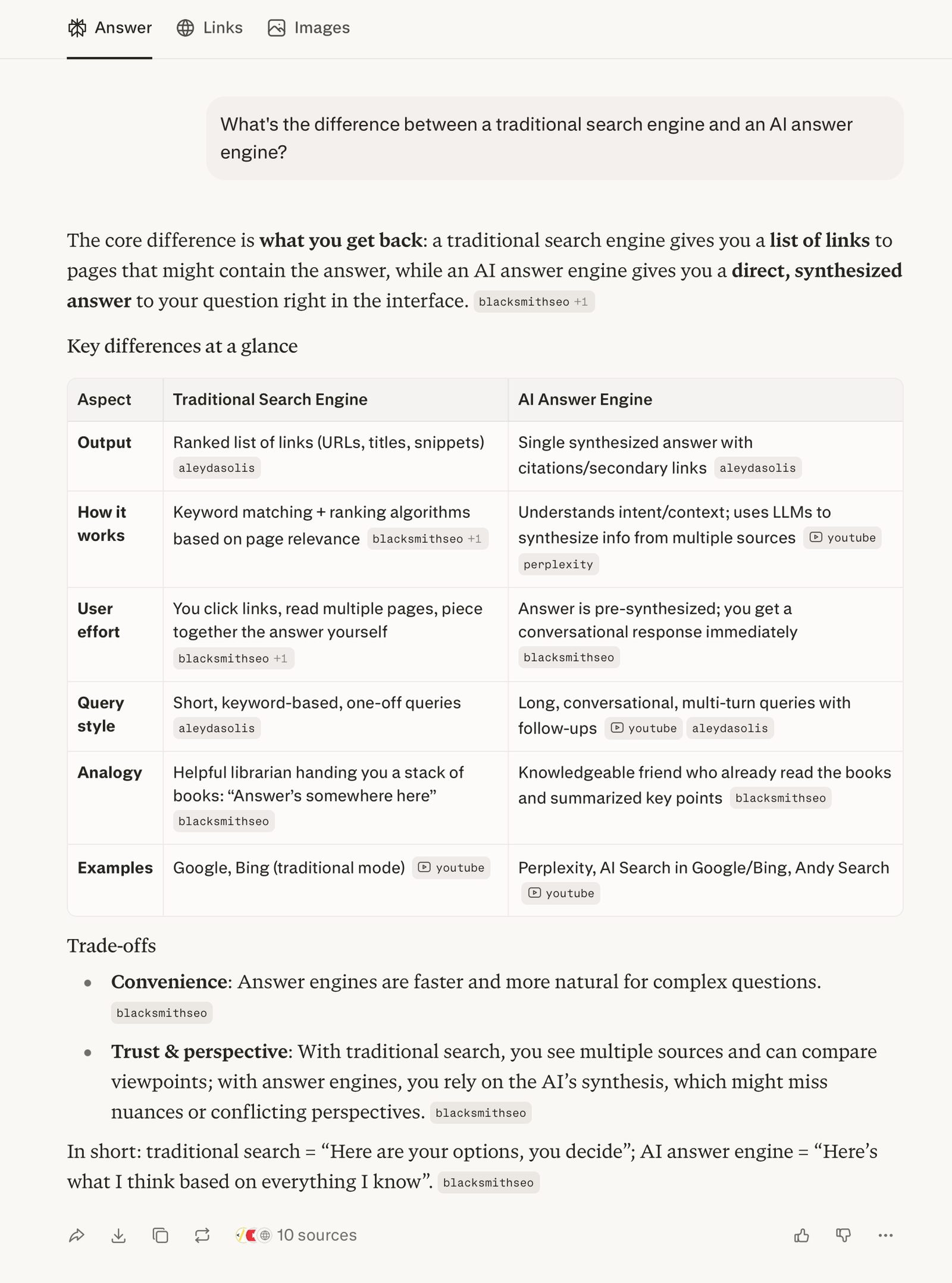
The citations are the part that changed how much I trusted the output. A regular chatbot will tell you something wrong with the same calm confidence it uses to tell you something right, and you have no way to tell the two apart. Here, every sentence had a receipt. When a claim surprised me, I clicked the source and read it myself. Sometimes the source said exactly what Perplexity claimed. Once or twice it didn't quite, usually on a number, and I caught it precisely because the link was right there. That's the practical difference between an answer you can act on and one you have to go re-verify from scratch. If you want the longer head-to-head on this, I'd already worked through how it compares with ChatGPT for research specifically, and the month mostly confirmed it.
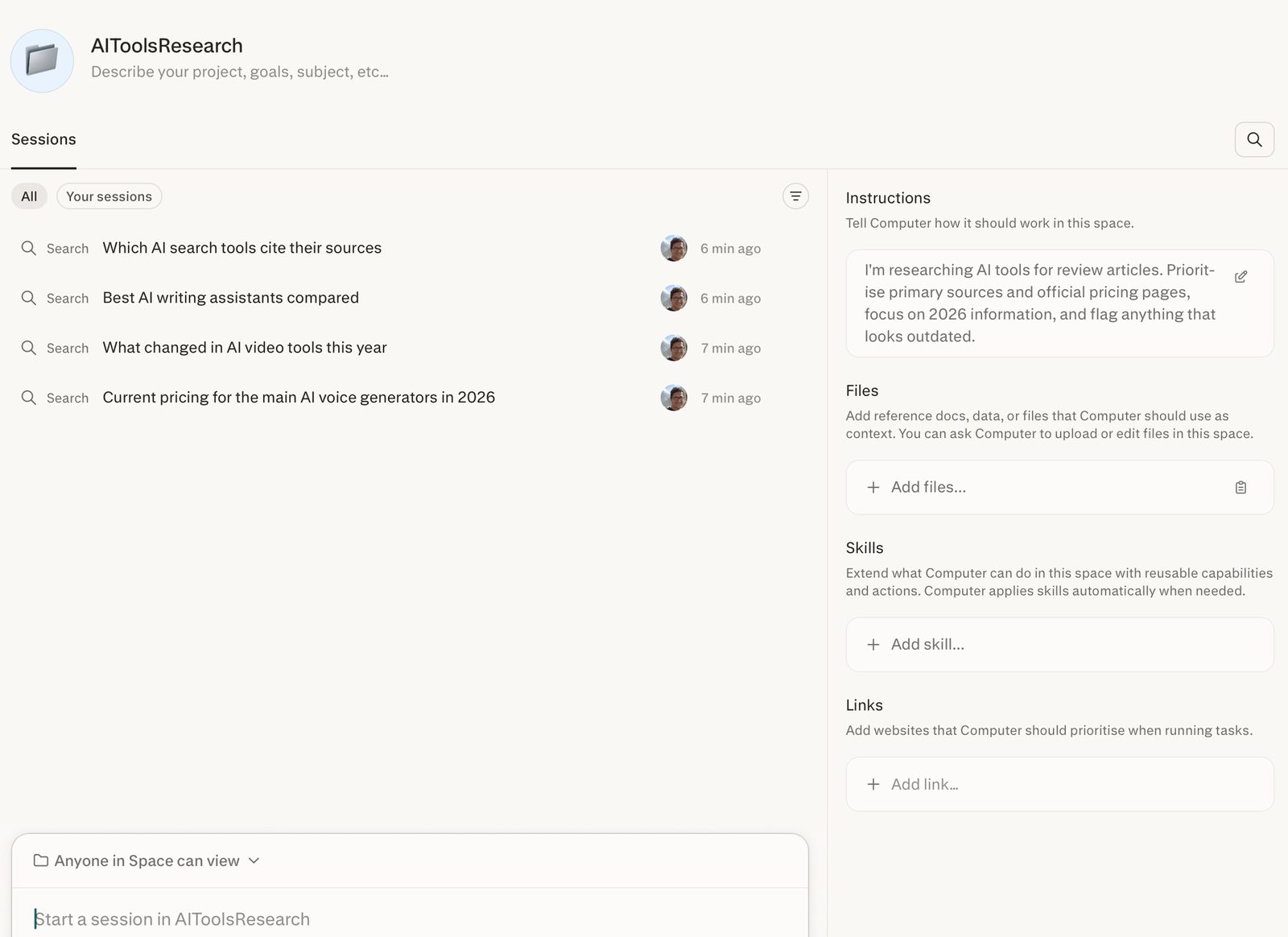
A week or so in, I started using Spaces, which are basically project folders for research. I set one up for an ongoing piece of work, gave it some custom instructions about what I cared about, and dropped every related search into it. Instead of a graveyard of disconnected queries, I had one place where the research accumulated and the tool remembered the context across sessions. For anything I was going to chip away at over days, that was the feature that made Perplexity feel less like a search box and more like a workspace. It's a different job from what a tool like NotebookLM does with a fixed set of your own documents, but the two scratch a similar itch: keeping research contained instead of scattered.
I also spent part of the month inside Comet, Perplexity's browser, where the assistant lives in a sidebar and can read the page you're on or go off and click through things for you. When it worked, it was a strange little glimpse of search that does the legwork instead of handing you links. It didn't fully replace my normal browser for me by the end of the month, but it changed what I expect a browser to be capable of, and I kept it installed.
Then there was the other half of the month: the searches where I quietly, repeatedly, reverted to Google. And once I noticed the pattern, it was hard to unsee.
The first category was navigation. Half of what I type into a search box isn't a question at all. It's a destination. I type "amazon" because I want to go to Amazon, not read a sourced summary of what Amazon is. I type the name of my bank's login page, or a tool's dashboard, or a half-remembered blog. For these, an answer engine is the wrong shape of tool. It thoughtfully composes a paragraph when all I wanted was the blue link, and the paragraph is slower than the link. Google, or really just the address bar, won every single time.
The second was local and time-sensitive lookups. Is this restaurant open right now. What's near me that's still serving food. How do I drive there. Google's map, its hours, its little "open now" tag, its reviews you can actually scroll: that whole local layer is something Perplexity will describe but can't replace. It would tell me a place's hours with a citation, and the citation would sometimes be a directory page that was out of date, while Google had the live hours pulled straight from the listing. For anything happening in physical space, I went back to Google without much guilt.
The third was the instant single fact. The weather. A currency conversion. A unit conversion. Last night's score. What time it is in another city. For these, Google's instant answer box sits at the very top of the page before you've finished reading the query, and there's nothing to beat about that. Perplexity gives you the same fact, correctly, with a source, a beat or two slower. When the whole interaction is supposed to take one second, a beat or two is the entire experience. I stopped fighting it.
And the fourth was shopping. When I'm comparing products I don't want a tidy verdict, I want to wade through options, see the images, scan the prices, read the angry one-star reviews. That's a browsing task, not an answering task, and a synthesised paragraph actively gets in the way of it. Perplexity would dutifully recommend the "best" option for my stated needs, but buying something is a decision I want to make by looking, not by being told, and a single summarised answer quietly removes the looking.
None of those are failures, exactly. They're category mismatches. Perplexity is an answering machine, and it's a good one. But I'd been treating "search" as a single activity for two decades when it was always at least five different activities wearing one box: research, navigation, a phone book, a dictionary, and a shopping mall. Perplexity took over the research job almost completely and left the other four mostly to Google.
On the money question, I spent nearly the whole month on the free tier and rarely felt the wall. Perplexity gives unlimited basic searches and a daily allowance of deeper Pro searches, and for someone doing a normal amount of research that allowance stretched further than I assumed it would. The day I was hammering a single topic, I hit the cap and felt the pinch, which is exactly the day that the $20 Pro plan would pay for itself. That's the honest line for cost: if research is a daily part of your work, Pro removes a real friction; if it isn't, the free tier is more than most people will ever need. Where Perplexity fits in a wider stack of everyday AI tools depends entirely on which of those two people you are.
So what did I actually stop using Perplexity for? Navigation, local search, instant single-fact lookups, and shopping. Roughly half of what I'd lazily called "searching" turned out to be tasks an answer engine makes slower, not faster, and I handed all of them back to Google before the month was out. What I kept it for is the half that always made Google feel like work: understanding something, comparing options, checking whether a claim holds up, and pulling current information with a source attached. That half, it does better than Google ever did.
If you take one thing from this, don't frame Perplexity as a Google replacement, because trying to make it do everything is how you end up disappointed by a tool that's excellent at its actual job. Frame it as the research half of search splitting off into its own product. Make it your first stop for questions that need thinking, and leave Google as the address bar, the map, and the store directory it quietly always was. The skill isn't picking a winner. It's knowing, in the half-second before you type, which kind of thing you're actually asking for. Once that became automatic, I stopped missing Google for the questions that matter and stopped pretending Perplexity wanted my dinner reservations.
For where this sits next to the writing-and-reasoning tools, the ChatGPT and Claude comparison covers the other corner of the map, and if your searches lean toward how your own content performs, the AI SEO tools roundup is the more relevant starting point than either a chatbot or an answer engine.