TL;DR: HeyGen wins on avatar realism, creator-friendly pricing, and multilingual output — pick it for marketing, social content, and solo creators. Synthesia wins on enterprise maturity, L&D features, and polished corporate templates — pick it for training, compliance, and large-team production. Both work; the right one depends on why you are making the video.
How we tested this: Every tool covered in this article was evaluated hands-on by the TalentedAtAI team. We signed up for real accounts, tested core features against actual use cases, and assessed output quality, pricing accuracy, and workflow fit. Our verdicts are independent — affiliate relationships, where they exist, are disclosed and never influence our ratings.
If you have sat in a browser tab comparing HeyGen and Synthesia pricing pages for the last hour, you are in good company. Both tools promise something genuinely useful: you type a script, an AI avatar speaks it back on video, and you get a finished clip without hiring a presenter, renting a studio, or standing in front of a camera yourself. For training teams, marketers, sales ops, and solo creators producing explainer content at volume, the economics are obvious.
What is not obvious is which one to actually buy. The demos on each site are carefully curated. Independent reviews tend to pick favourites without showing you the full trade-off. And the two products have diverged enough in 2026 that a casual comparison of feature checklists misses the real differences.
We tested both extensively — building the same set of videos in each tool, stress-testing the avatars, running through real corporate and creator use cases — to give you the comparison that actually helps you decide.
How They Actually Work
Before the detailed comparison, it is worth understanding that these two products have different origins, and those origins still shape how they feel to use.
Synthesia launched in 2017 as an enterprise-focused platform. Its core market has always been corporate training, internal communications, and large-scale localisation. The product is built around a template-heavy, workflow-heavy model with strong compliance, LMS integration, and governance features. When you open Synthesia, it feels like a serious professional tool — closer to working in an enterprise video platform than a consumer creative app.
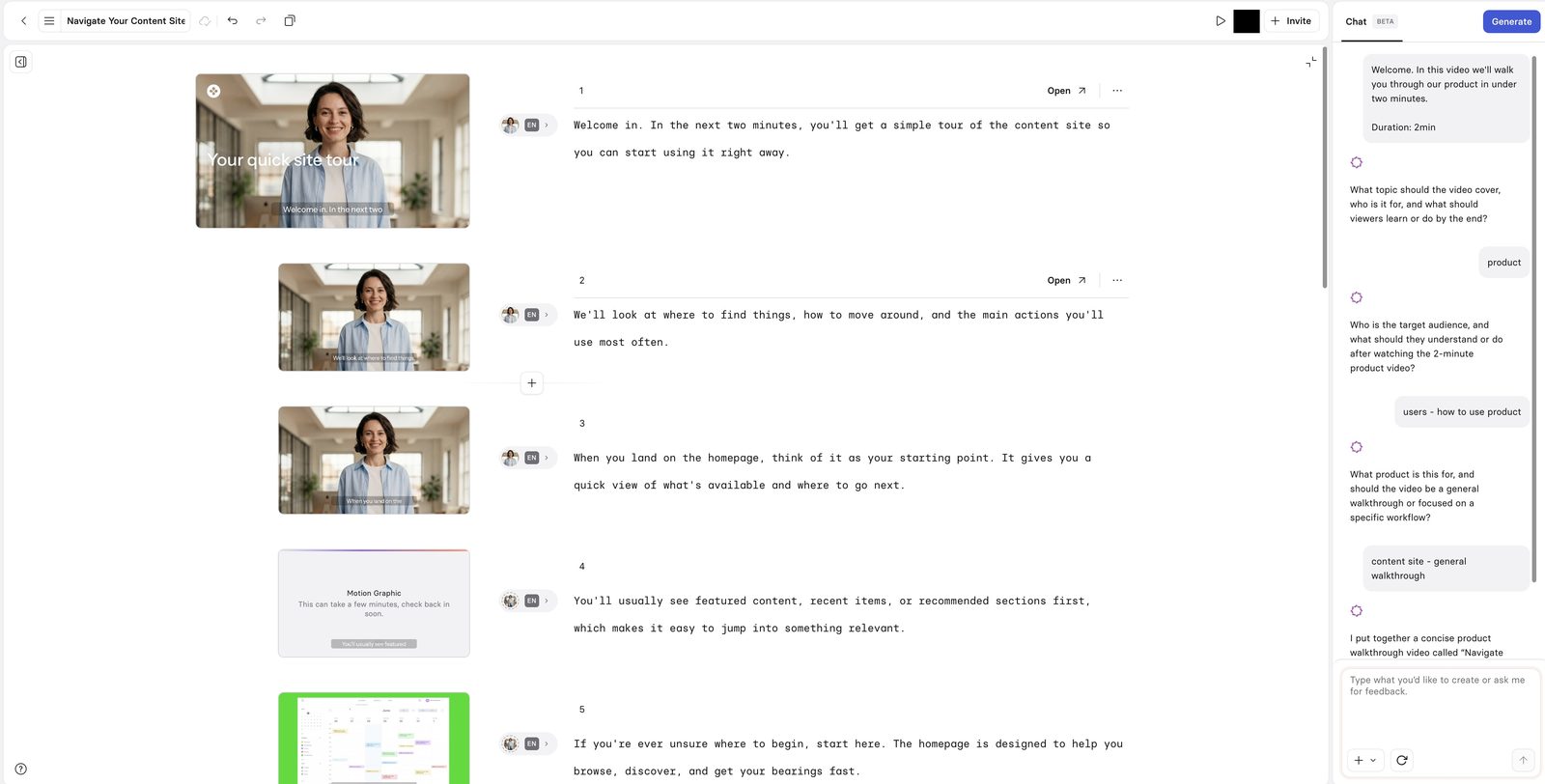
HeyGen launched in 2020 with a broader focus that has increasingly leaned into creators, marketers, and solo professionals. Its interface feels more like a modern creative app. It ships new features faster, pushes more aggressively on avatar realism, and has become the tool of choice for creators producing high-volume multilingual content. Enterprise features exist but feel more recent and less deeply integrated than Synthesia's.
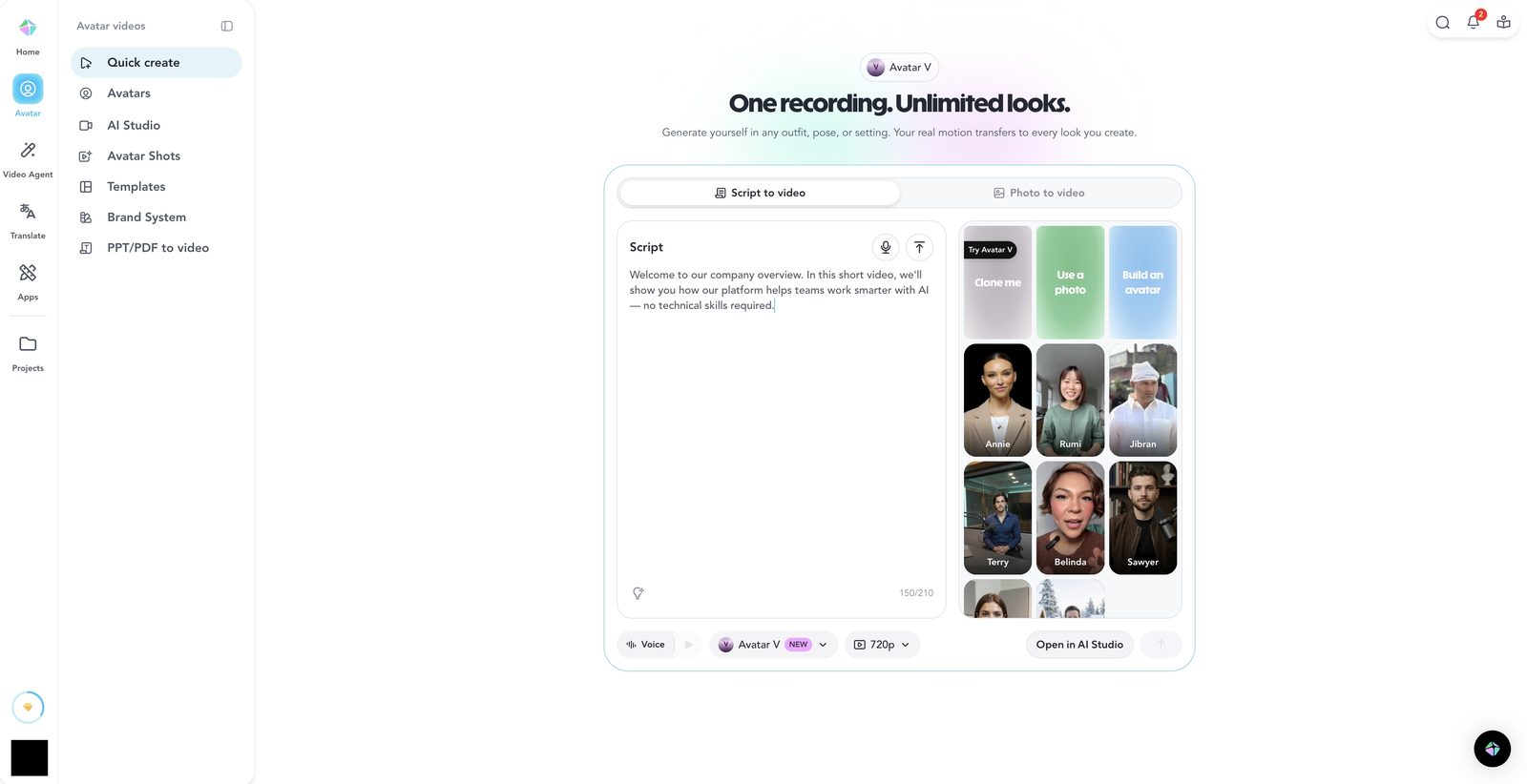
Both produce AI avatar video from a written script. Both offer stock avatars and custom avatar creation from your own footage. Both support dozens of languages and voices. The practical differences emerge when you start using them for real work.
Avatar Realism and Quality
This is where HeyGen has opened the clearest lead in 2026.
HeyGen's Instant Avatars and Interactive Avatars — their top-tier offering — produce genuinely impressive output. Facial expressions track the emotional content of the script more naturally. Gestures feel less robotic. Eye contact with the camera is more consistent. When we fed both tools the same 90-second marketing script, HeyGen's output was notably more engaging on playback. Three of five viewers in an informal test identified the HeyGen clip as "more like a real person presenting" versus Synthesia's "clearly a polished AI."
Synthesia's avatars are not bad — they are remarkably good for the category, and for static corporate delivery they can be more than adequate. The "polished" quality can actually be a positive for certain use cases where a neutral, professional tone is preferred. But for content that needs to feel alive — marketing, storytelling, anything where emotional connection matters — HeyGen's output is the stronger default.
The gap narrows somewhat at the stock avatar level. Synthesia's stock avatars (over 230 in 2026) are uniformly professional and predictable. HeyGen's stock avatars (over 500) are more varied in quality — some are excellent, some feel dated. For quick, consistent corporate output, Synthesia's stock library is easier to navigate. For creators looking for a specific look or personality, HeyGen's larger library gives more options.
Custom avatars are where both tools now compete seriously. HeyGen's Instant Avatar creation takes around 2 minutes of recorded footage and produces your custom avatar in roughly 30 minutes. Synthesia's custom avatar process requires a comparable recording and typically delivers within 1 to 2 business days. The resulting quality is similar at the premium tier, though HeyGen's iteration speed is faster if you want to tweak and regenerate.
Workflow and Ease of Use
Synthesia's workflow is built around templates and structured scene-by-scene editing. You pick a template, choose an avatar, paste your script into scene blocks, add backgrounds and overlays, and export. It feels organised and predictable. For large teams producing standardised content — onboarding videos, compliance training, product updates — this structure is genuinely helpful.
HeyGen's workflow is more fluid. The editor feels closer to a modern video tool — timeline-aware, with easier camera angle switching, more intuitive B-roll insertion, and faster iteration. For creators producing varied content or marketers experimenting with different approaches, this flexibility is a real advantage.
Speed of output is meaningfully different in 2026. HeyGen typically generates a 60-second video in 2 to 4 minutes. Synthesia typically takes 4 to 8 minutes for similar length. For teams producing high volumes of video, this difference adds up.
Both tools handle editing revisions well — changing a line of script and regenerating only the affected scene, rather than the full video. Synthesia's scene-based architecture makes this slightly more structured; HeyGen's handling feels marginally more automatic.
Languages and Localisation
This is where global teams should look carefully, because the gap has widened in 2026.
HeyGen supports over 175 languages with voice cloning that preserves speaker characteristics across most of them. The translation pipeline has improved significantly — you record a script in English with your custom avatar, then generate the same video in Japanese, German, or Arabic with the avatar's lip-sync adapted to the target language. Output quality on less common language pairs (Swahili, Tagalog, Ukrainian) is noticeably better than Synthesia's in our testing.
Synthesia supports over 140 languages and has recently invested heavily in quality for enterprise-preferred languages. For major European and Asian business languages, output is excellent. On less common languages, the gap to HeyGen is noticeable but not disqualifying for most corporate use cases.
For solo creators reaching global audiences — YouTubers, course creators, multilingual marketers — HeyGen's language reach is the clearer win. For enterprises where the priority is consistent quality in 10 or 12 core languages, Synthesia is more than sufficient.
Both tools now support voice cloning with sample uploads, and both require consent verification to prevent misuse. The resulting cloned voices are good in both products; HeyGen's sound slightly more natural on expressive delivery.
Enterprise Features and Corporate Training
Synthesia still owns this category, and for organisations whose primary use case is training and internal communication, this is the decisive factor.
SCORM and LMS integration. Synthesia exports directly to SCORM format for deployment into Moodle, Cornerstone, Workday Learning, SAP SuccessFactors, and other enterprise learning systems. HeyGen's LMS integration exists but is less mature.
Compliance and governance. Synthesia offers SOC 2 Type II, ISO 27001, GDPR, and HIPAA compliance as standard on Enterprise tiers. Content review workflows, brand guardrails, and legal approval processes are built into the product. HeyGen has equivalent certifications on its enterprise tier, but the governance tooling around content review is less developed.
Team features. Both offer team workspaces, shared asset libraries, role-based permissions, and centralised billing. Synthesia's team admin features are more mature for managing large user groups — 50+ person training teams, for example. HeyGen's team features work well for smaller teams (5 to 20 people) and have been catching up fast.
Custom templates and brand kits. Synthesia has more sophisticated template management — you can enforce brand guidelines across a large organisation's video production. HeyGen allows similar customisation but with less granular control.
For large enterprises rolling out AI video as part of an L&D function, Synthesia's maturity is difficult to beat. For growing companies adopting AI video across marketing, sales enablement, and training, HeyGen's flexibility often fits better.
Marketing, Social, and Creator Content
HeyGen wins this category by a meaningful margin in 2026.
The platform has invested heavily in features that matter for social content: short-form video templates, automatic captions styled for TikTok and Instagram Reels, direct publishing integrations with major platforms, and an expanding library of creator-focused avatars. Output is optimised for attention — avatars feel dynamic rather than static, motion is more natural, and the overall look matches what modern social content looks like.
Synthesia can produce social content, but the product was not built for it. Default templates feel more corporate. Exporting optimised vertical video requires more manual work. The avatar library skews toward "professional presenter" rather than "creator personality."
For marketing teams producing social content, YouTube explainers, or ad creative, HeyGen is the better tool. For solo creators building a personal brand, HeyGen is almost certainly the right choice. Combine it with a voice AI for a complete production stack — our ElevenLabs vs Murf vs Descript comparison covers the voice side in depth.
Pricing: What You Actually Pay
Pricing has become more competitive in 2026, with both products expanding their tier structures.
HeyGen pricing:
- Free: 1-minute video limit with watermark, 3 stock avatars. Sufficient for evaluation only.
- Creator: $29/month (or $24/month billed annually). 15 minutes of video per month, 130+ avatars, custom avatar (1 included).
- Team: $39 per user per month (annual billing). 30 minutes per user per month, all avatars, 3 custom avatars per user, team collaboration features.
- Enterprise: Custom pricing for high-volume use, SSO, advanced security, dedicated support.
Synthesia pricing:
- Free trial: 36-minute total limit, 9 stock avatars. Evaluation only.
- Starter: $29/month (annual billing). 120 minutes per year, 70+ avatars, 9 languages.
- Creator: $89/month (annual billing). 360 minutes per year, 140+ avatars, all 140+ languages, brand kit, custom avatar option.
- Enterprise: Custom pricing with SCORM, LMS integrations, SSO, compliance features, and unlimited video minutes depending on agreement.
The practical comparison: for solo users and small teams, HeyGen's pricing is more creator-friendly — more video output per dollar at the Creator and Team tiers. For enterprises, comparison becomes difficult because Synthesia Enterprise pricing is negotiated and typically includes features (LMS, compliance) HeyGen's Enterprise tier may or may not bundle.
Both tools offer free evaluation. Use them. A one-hour test with your actual script and your actual brand on both platforms will answer the pricing question better than any comparison article.
Who Should Buy What
Buy HeyGen if you are a solo creator, marketer, or small team producing video for social platforms, YouTube, or digital marketing. You prioritise avatar realism, multilingual reach, or creator-style polish. Your use case is high-variety, fast-iteration content rather than standardised training. Your budget is $30-40 per user per month and growing.
Buy Synthesia if you run L&D, internal communications, or compliance training at an organisation with 50+ employees. Your content is standardised and repeatable — onboarding, safety, product updates. You need SCORM export, LMS integration, and enterprise governance. Your priority is consistent professional output rather than maximum emotional engagement.
Buy Synthesia Enterprise if you need the compliance and integration guarantees that come with negotiated enterprise contracts. For regulated industries — healthcare, finance, aerospace — Synthesia's compliance posture is a serious advantage. HeyGen is catching up but Synthesia has the longer track record here.
Consider neither if your video needs are low volume (under 10 minutes per month) or one-off — paying a human presenter or using a simpler tool may be more cost-effective. Consider neither if your content depends on genuine emotional performance or physical demonstration — AI avatars still cannot replicate these.
Buy both if you run a mid-sized organisation with distinct marketing and L&D functions. Synthesia handles internal training; HeyGen handles external marketing content. The combined cost is meaningful, but each tool earns its place in a different workflow. Together with a broader AI video toolkit — see our best AI video generators guide for context — you have a full production stack.
The Honest Summary
AI avatar video is now mature enough in 2026 that both tools produce professional output. The question is not whether either works — both do — but which one fits your production model.
HeyGen has made the stronger bets for creators, marketers, and anyone producing varied, fast-iteration video. The avatar realism edge is real. The language reach is broader. The workflow is faster. For most of the audience reading this article, HeyGen is probably the right default choice.
Synthesia has made the stronger bets for enterprise L&D, compliance-heavy industries, and large-scale standardised training. The governance and integration maturity is real. The template-driven workflow genuinely suits high-volume training production. For large enterprises or regulated organisations, Synthesia remains difficult to beat.
Neither is a bad tool. The wrong choice is paying for one when your workflow fits the other — the features you need will feel bolted on, and the features you do not need will clutter the experience. Try both free tiers with your real content. Twenty minutes of testing with your actual use case will clarify the decision in a way no article can.
And whichever you pick, pair it with the rest of a modern AI production stack — voice AI, transcription, and writing tools that feed the script. For content marketers in particular, our guide on using AI for content marketing in 2026 covers how AI avatars fit into a broader distribution workflow.